


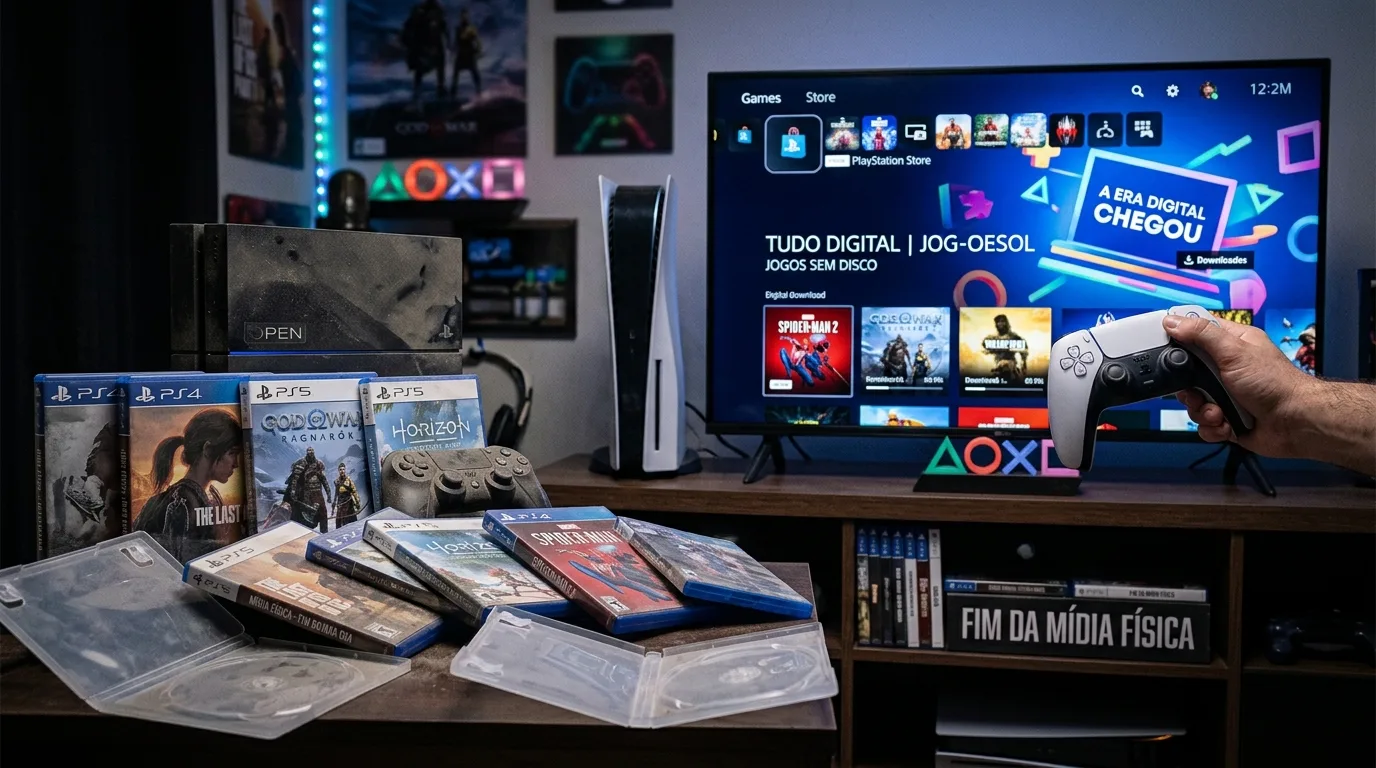
Sony has confirmed the end of production of physical disc media for all new PlayStation games starting January 2028. The decision applies to new console releases like the PS5 and future hardware, keeping only digital distribution via the PlayStation Store and authorized retailers. The move, justified as aligning the company with consumer behavior, has sparked strong backlash in the community: an online petition against the shutdown has already surpassed 280,000 signatures in a few weeks, while renowned developers and retail associations express deep concern over the definitive loss of game ownership rights.
The Radical Shift: From Physical Disc to Revocable License
The transition announced by Sony marks the first time in history that a major console manufacturer has decided to completely abolish discs for future releases. Titles published before January 2028 will continue to be available in physical format as usual. However, for new games, purchases will be restricted to digital files directly linked to the user's account.
The Japanese giant justified the shift with internal market data: digital sales already account for over 80% of total software sold on PS4 and PS5, a striking contrast to the less than 10% recorded before the PS4's launch. Additionally, data from Circana reveals that U.S. consumer spending on new discs has fallen to $1.6 billion over the past 12 months — just a fraction of the $11.5 billion peak reached in 2009.
The main point of contention is not the sales volume, but the legal and practical nature of the purchase. When buying a game disc, the consumer purchases a tangible item that can be lent, traded, sold on the used market, or played without an internet connection. In contrast, with a digital purchase, the consumer only acquires a usage license. If the console store shuts down, the license with the publisher expires, or the user's account is suspended, access to the game can be permanently lost.
Server Outages and the Closure of Historic Stores
Players' apprehension grew significantly because, on the same day it announced the end of discs for 2028, Sony also communicated the timeline for the definitive shutdown of the PlayStation Store for the PlayStation 3 and PlayStation Vita. Purchases on PS3 will begin to be phased out regionally in 2026, culminating in a global shutdown in July 2027. Although previous downloads will remain available temporarily, the move reinforces the expiration date of digital libraries.
Recently, temporary outages in Sony's servers exposed the bottleneck of online verification. During the system downtime, user accounts were locked, and even digital games focused on single-player campaigns could not be launched, as the console was unable to authenticate usage licenses with the central servers. The episode served as a real-world warning for the scenario where support for a given hardware is discontinued.
Developers and Industry Leaders Criticize the Decision
The backlash was not limited to discussion forums. Dan Houser, co-founder of Rockstar Games and current head of studio Absurd Ventures, sided with players' choice in a recent interview at San Diego Comic-Con: "If people want the disc, I believe companies should provide it. While digital distribution is useful for applying patches and improving game quality post-launch, the physical option remains essential."
Legendary director Hideo Kojima publicly lamented the change during an appearance at a film festival in Italy, stating that he grew up with physical media and finds its disappearance sad. Meanwhile, Kim Bayley, CEO of the Entertainment Retailers Association (ERA), highlighted that a quarter of players under 25 in the United Kingdom still use discs, a market that moved £300 million last year. Bayley emphasized that discs can be shared with family, collected, and played decades later—freedom that digital licenses do not offer.
Who Really Benefits from the End of Discs?
The shift to a 100% digital ecosystem profoundly alters profit margins and market control in favor of the platform and publishers:
- Elimination of operational costs: Sony ends expenses for manufacturing physical media, plastic packaging, freight transport, distribution logistics, and retail margins from physical stores.
- End of the used game market: Without discs in circulation, the trade and resale of pre-owned games among players disappears—a market from which Sony earns no revenue.
- Absolute control over pricing: Without price competition from physical retail and inventory disputes between stores, the suggested retail price (MSRP) on the official store becomes the sole reference in the ecosystem.
- Reduction in hardware costs: The permanent removal of the disc drive lowers manufacturing costs for future consoles.
For the consumer, the only visible advantage lies in the convenience of immediate download. On the flip side, traditional ownership rights are lost, along with the ability to recoup part of the investment through resale, and accessibility in regions with limited internet infrastructure or data caps, since modern games often exceed the 100 GB mark.
Despite strong rejection and growing petitions, gaming industry analysts consider a retreat by Sony unlikely. The scale of subscription cancellations or boycotts so far has not been enough to impact the company's financial strategy, which sees digital consolidation as the definitive path for the PlayStation ecosystem in the coming decades.