What Are Serialized Magic: The Gathering Cards?
Published on · Updated on
Numbered, limited and expensive: how Magic: The Gathering serialized cards work and why the signed Picard card sold for $26,000 on eBay in November 2026.

A signed Jean-Luc Picard card — the captain played by Patrick Stewart in Star Trek — sold on eBay for about $26,000 in November 2026, and later listings were asking between $38,000 and $45,000 for the same kind of item. The value does not come from the autograph alone: it comes from the format Wizards of the Coast calls a serialized card, a numbered version with a fixed, published print run found only in Magic: The Gathering Collector Boosters. The mechanism turned a piece of cardboard with the same rules text as always into a finite object — and that is what keeps prices high on the secondary market.
What exactly is a serialized card
A serialized card is a printing that carries, stamped on the art or the frame, a number showing which copy it is within a closed print run. The stamp “042/500”, for example, means that card is the 42nd of exactly 500 produced. No other copy is the same: every single one receives a different number, which gives collectors mathematical certainty about the size of the run.
That precision is the opposite of what Magic offers everywhere else. Wizards of the Coast never discloses how many copies of a regular rare or mythic rare exist in the world; rarity is a printing category, not a number. With serialization, the ceiling becomes public, and the market can price the card based on a known scarcity.
The number is usually hot-stamped over the art box and comes with the finish the company calls double rainbow foil. Serialized cards appear only in Collector Boosters, the premium product in the line, and they are always in English, even when pulled from boxes in other languages.
In practice, the card plays exactly like any other version of that card. Rule 206.4 of the Comprehensive Rules is explicit: printed information that does not affect the game, such as the serial number, does not change how a card works. It remains legal in Commander, Legacy or any format where the regular version is allowed — and it still counts as your single copy under Commander’s singleton rule. Do not confuse the serial number with the collector number, though: the latter is the same on every copy and shows the card’s position in the set list.
“Each of the 63 schematic cards has 500 serialized versions. Each serialized card is numbered from 1 to 500 and appears on a double rainbow version of our traditional foil.”
How the format was born and became a Wizards standard
Serialization arrived in Magic as a quiet experiment. In November 2021, the Secret Lair drop Phyrexian Praetors: Compleat Edition included a mirrored Viscera Seer numbered from 001/100 to 100/100, with little fanfare. The idea only became a product category a year later, with The Brothers’ War: 63 artifacts with schematic art in retro frames, each with 500 copies, totaling 31,500 cards spread around the world in Collector Boosters, at a pull rate below 1% per pack.
Since then, the format has been adjusted several times, almost always toward smaller print runs and a single “prize” per set. The table below summarizes the main milestones disclosed by Wizards itself and by the community archive at MTG Wiki:
| Year | Release | Serialized format | Print run |
|---|---|---|---|
| 2021 | Secret Lair — Phyrexian Praetors | Mirrored Viscera Seer | 100 copies |
| 2022 | The Brothers’ War | 63 retro schematic artifacts | 500 each (31,500 total) |
| 2023 | March of the Machine | 65 Multiverse Legends | 500 each |
| 2023 | The Lord of the Rings: Tales of Middle-earth | The One Ring | 1 copy worldwide |
| 2024 | Murders at Karlov Manor | 7 legendary creatures | 250 each (1,750 total) |
| 2024 | Fallout | 7 bobbleheads | 500 each |
| 2026 | Magic: The Gathering | Star Trek | 7 hand-signed Headliners | fewer than 250 each |
The most famous case remains The One Ring: a single copy, found in 2023 and sold to rapper Post Malone for a reported sum above $2 million. It did not follow the 500-copy model, but it pushed the same logic — known quantity plus a strong intellectual property — to its limit. The commercial success of the model led Wizards to repeat the formula in Doctor Who, Assassin’s Creed, Ravnica Remastered and the Universes Beyond line.
Why a numbered card is worth so much
1. The print run is known and small
Knowing that only 250 or 500 units exist changes the negotiation. Instead of comparing against an abstract rarity, the buyer is dealing with a closed universe: if 30% of the copies sit in permanent collections, the available supply is even smaller. It is the same logic the sports card market has used since the 1990s.
2. Playability sets the floor
Scarcity without usefulness does not sustain a price. Serialized copies of heavily played cards are worth several times more than those of characters with no room in decks. Mox Amber, from The Brothers’ War, is listed at around $2,000 to $2,500; Ragavan, Nimble Pilferer, from March of the Machine, sits near $1,000. Legends with no competitive use stay in the hundreds.
3. Intellectual property multiplies it
The Fallout bobbleheads, which see almost no play, settled between $350 and $550 purely on brand value. The same reasoning applies to Star Trek: the buyer is not paying for an efficient card, but for a piece of a 60-year-old franchise.
4. The number itself becomes a trophy
Collectors pay a premium for 001/500, for the last copy in the run and for numbers with a meaning, such as 069 or 420. It is not isolated superstition: it is a trophy market, where the identity of the copy matters as much as the card.
5. The autograph and the human context
With the Star Trek Headliners, there is an extra layer. Each card was printed, physically signed by the actor and randomly inserted into a Collector Booster — it is not a reproduced or facsimile signature. When the biographical context changes, the price changes with it.
The Star Trek case: $26,000 for a Picard autograph
Magic: The Gathering | Star Trek reached stores on November 13, 2026, with prerelease events from November 6 to 12 and an MTG Arena launch on November 10. The set celebrates the franchise’s 60th anniversary and is Standard legal. The product line includes $6.99 Play Boosters, $37.99 Collector Boosters and four Commander decks.
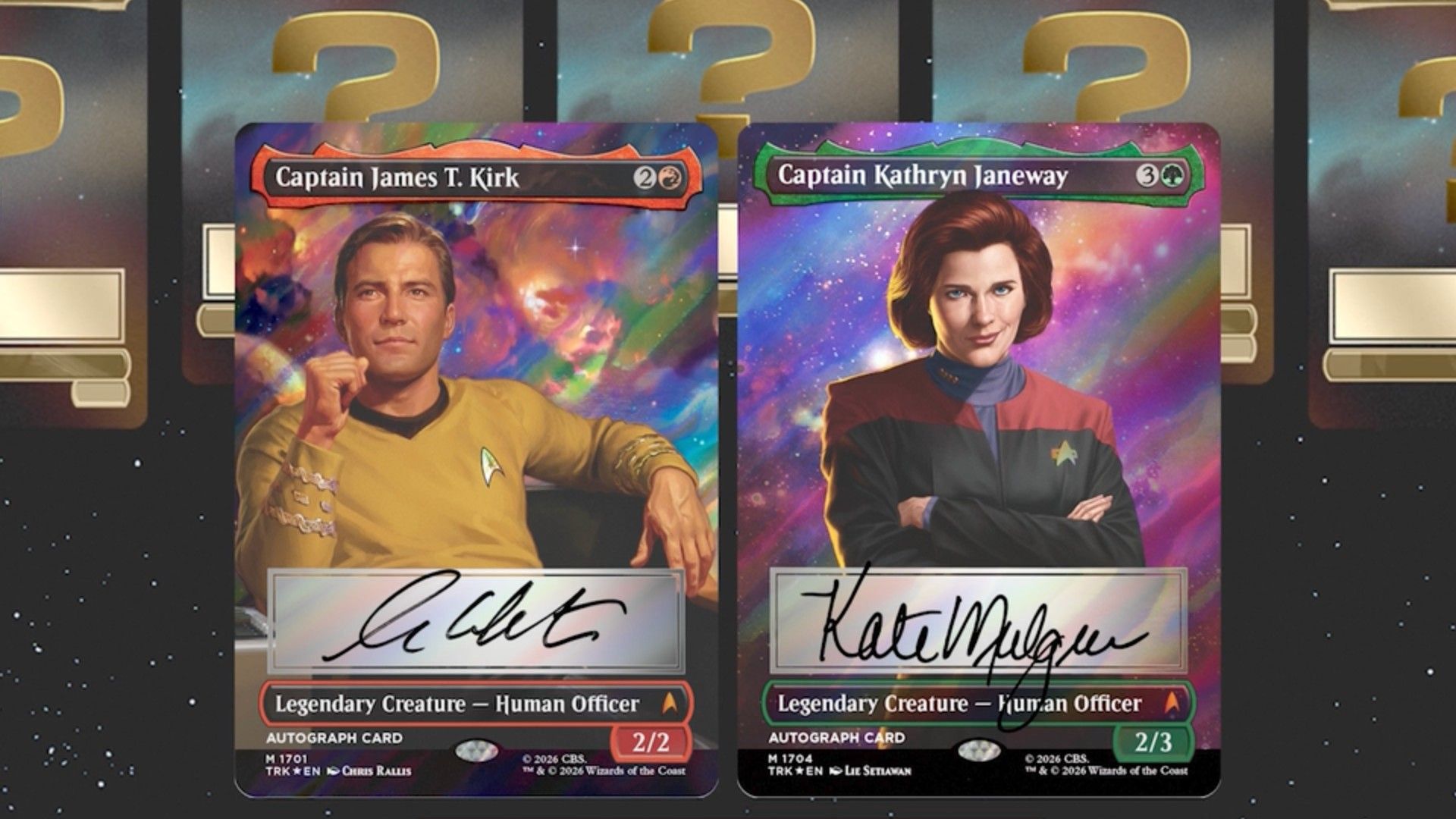
The main draw is the seven signed Headliners. Wizards confirmed the names, in the set’s official collecting guide, of William Shatner (Kirk), Patrick Stewart (Picard), Brent Spiner (Data), Kate Mulgrew (Janeway), Jeri Ryan (Seven of Nine) and LeVar Burton (Geordi La Forge), plus Mr. Spock. There are fewer than 250 copies of each, always in English, available in Collector Boosters of any language.
“There are 7 different signed cards in Magic: The Gathering | Star Trek. There are fewer than 250 copies of each signed card, and each features a signature from a Star Trek actor.”
According to the report published by TheGamer on November 18, most signed Star Trek cards had been trading between $5,000 and $10,000. An eBay listing for the Picard version reportedly sold for $26,000 — a figure that, per the report, may have come from an offer below the asking price. More recent listings were asking $38,000 and $45,000, which helps explain the confusion between asking price and price actually paid.
The reason given for the surge is a sad one. Patrick Stewart died on October 28, 2026, at 86, in Los Angeles, after complications related to Alzheimer’s and Lewy body dementia. Because the cards were signed before his death, they began to be treated as some of the last items the actor ever autographed. Fans openly criticized attempts to profit from his passing, but there is no sign that supply will loosen: the print run remains fixed at fewer than 250 units per character.
Revista Pixel has already covered the actor’s farewell in the report on Patrick Stewart’s death and his impact on Star Trek and X-Men. Readers who want to follow the game’s move to the screen can also check the analysis of the Magic: The Gathering animated series on Netflix.
What to do if you open a serialized card
- Do not play with it. The number does not change the rules, but wear and tear destroys value. Use the regular version in your deck and keep the serialized copy in a rigid sleeve and a top loader.
- Photograph it before moving it. Record the serial number, corners, surface and any factory defect. Those images serve for grading reports and listings.
- Grade it before selling. Services such as PSA, BGS and CGC grade and encapsulate cards. On four- or five-figure items, the report usually pays for itself.
- Verify authenticity for autographs. Hand-signed cards require provenance checks and comparison with known examples; be wary of sellers with no history.
- Compare sold prices, not asking prices. Platforms such as eBay show transaction history, and the gap between an active listing and a completed sale is huge at the top of the market.
- Add fees and taxes. Platform commissions, insured shipping and import duties can eat a large share of the gain in international deals.
A market that is starting to cool
Not every serialized card is a treasure. Industry surveys suggest that, on average, a numbered card is worth three to four times its non-numbered version — a relevant difference, but far from the multipliers seen in 2022. The Brothers’ War artifacts range from about $250 for unappealing names up to $1,000 to $2,500 for the most wanted ones.
The Collector Booster market itself has gone through a correction. Boxes with presales near $1,000 fell below $300 after release in some 2025 sets, according to an analysis published by Misprint. The explanation is simple: when every set has a serialized chase, the novelty wears off and collectors become pickier about where to bet.
Wizards’ response was to reduce the number of serialized cards per release and concentrate the prize on a single card — the so-called Headliner era, which began with Edgar Markov in Innistrad Remastered, whose numbered version was listed near $2,400. Fewer options mean more demand concentrated on each one. That is the same move the Star Trek set repeats now, with seven characters and fewer than 250 copies of each.
For the average player, the side effect is familiar: serialized luxury helps keep regular card prices at playable levels. For collectors, the message is the usual one — known scarcity is not a guarantee of liquidity. A serialized card is only worth what someone is willing to pay on the day of the sale.
What to watch going forward
The Picard card shows how the format works when three factors line up: a low print run, an iconic character and an event that rewrites the emotional value of the item. Without one of those elements, a serialized card goes back to being just a numbered foil variant.
In the coming seasons, three signals are worth following: the size of the print runs Wizards announces, the performance of the cards in tournaments — which sets the price floor — and the real volume of completed sales on second-hand platforms. As long as the company keeps the stamp in Collector Boosters and numbering remains the main selling argument, the market should stay split between four-figure pieces and cards nobody wants, separated by a single detail printed on the art.
With information from TheGamer, Wizards of the Coast, MTG Wiki, Beckett and Misprint.
Suggested and related articles

New Star Trek: what's confirmed and what's still a guess
What Is Leonidafication in GTA 6? Meaning Explained

The Mongoose: Liam Neeson Tops Prime Video Worldwide

007: What We Know About Villeneuve's Bond Film
GTA 6 at The Game Awards 2026: All Eight Nominations