
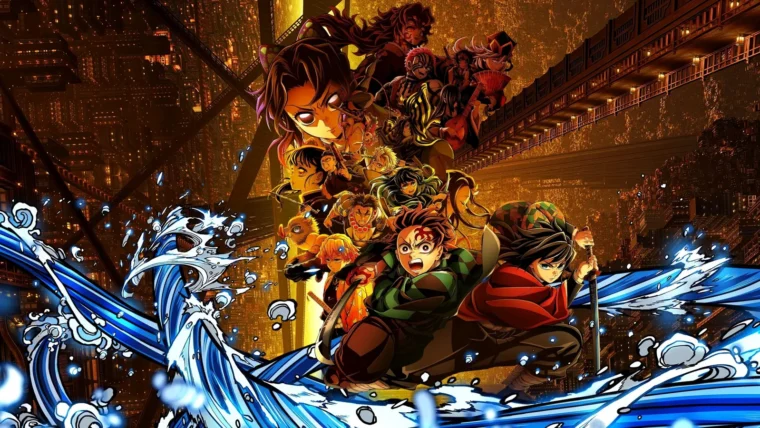
There’s no denying it: Demon Slayer: Infinity Castle" is a massive hit, earning millions in its opening weekend. Studio ufotable‘s animation quality remains at a rarely seen level, the battles are electrifying and the emotional moments that deepen the characters are all there. Everything that made the franchise a global phenomenon is present. However, the film is sold as a movie, and that raises a crucial question: is it a good movie? And the answer is complicated.
If we judge Infinity Castle" strictly as a cinematic work, it suffers from a fundamental problem: its pacing. The action, which should be the focus of this story arc, is constantly interrupted by flashbacks, reflections and digressions. The result is frustrating and makes us question whether the movie format was the best choice for this part of the saga.
What Works in the Manga May Not Work in Cinema
Any longtime shonen fan knows this narrative structure is the bread and butter of classics like Naruto and Bleach. The action pauses to make room for character development, motivations and tragic pasts. Demon Slayer is a master of this, creating empathy even for the cruelest demons. The problem is that the language of manga and episodic anime does not translate perfectly to cinema.
Manga and anime are designed for the serialized format. They build tension in a crescendo and end on a cliffhanger, bringing the audience back the following week. A film, by definition, is a more compact and self-contained work. It benefits from uninterrupted pacing, especially an action film. Watching Infinity Castle" is like driving a powerful sports car whose engine overheats every few minutes. The adrenaline of speed is quickly cut by a forced stop, and that creates not tension, but frustration.
Even though it faithfully reproduces the narrative style of Koyoharu Gotoge, the manga’s creator, the feeling remains that the adapted chapters (140 to 156) were stretched to fill a feature-length runtime. It was a commercially sound decision, but one that hurt the experience.
The Inevitable Comparison With Mugen Train"
The franchise itself has already proven it can produce an excellent film. Mugen Train", the first feature, adapted even fewer manga chapters and yet feels much more like a cohesive movie. Why? The answer lies in the nature of the arc.
The Infinity Train arc was perfect for cinema: short, contained and with few characters in a single location. That resulted in much tighter pacing, with a narrative flow that was rarely interrupted. Infinity Castle", on the other hand, follows more than twenty characters, split into small groups and lost in a chaotic dimension. It is a survival battle that replicates a classic shonen trope: the heroes split up to face several powerful enemies at the same time. It is an inherently episodic structure which, worse still, does not conclude here, leaving us with a cliffhanger for the next film.
A Different Experience for Every Type of Fan
It is crucial to note how the viewing experience changes depending on your history with the franchise. As a manga reader who already knew the emotional outcomes, my attention was focused on the action and the visual spectacle. For me, the pauses were frustrating. Yet for a friend who only follows the anime, those same scenes were the highlight, provoking tears and deep emotional engagement.
What are pacing flaws for one group are essential moments of depth for another. That says a lot about the quality of the franchise’s character building, but it also exposes how hard it is to please everyone with this format. The moments that shine for newcomers are the ones that break immersion for those who already know what is coming.
Verdict: An Essential Piece of the Anime, but a Flawed Film
In the end, Demon Slayer: Infinity Castle" is a dazzling work of animation and a must-watch chapter for any fan of the saga. The fights, when they happen, are breathtaking, especially the clash between Tanjiro, Giyu and the demon Akaza in the second half. Yet as a standalone piece of cinema, it fails to sustain engaging pacing.
Turning the final arc into three films was undoubtedly the best financial move. But for the viewing experience, a well-structured anime season would have served the story much better. Infinity Castle" is less a movie and more a collection of luxury episodes shown on the big screen. Essential for fans, but frustrating for anyone expecting a great film.
💬 Comentários (0)
Deixe sua teoria ou opinião sobre esta matéria.
Nenhum comentário por enquanto. Seja o primeiro a comentar!