
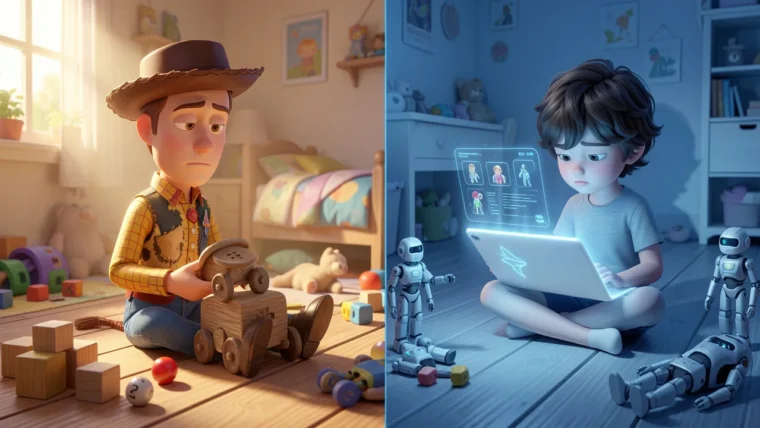
The Toy Story franchise is one of the most beloved in the world of animation. After more than 30 years of history, each new chapter carries enormous expectations — and a natural skepticism. Is there still anything left to tell with Woody, Buzz and Jessie? The fifth film, directed by McKenna Harris and Andrew Stanton, surprises precisely by not trying to repeat the formula, but by looking at a theme that spans generations: how technology redefines the way children play.
At 102 minutes, Toy Story 5 arrives in theaters bringing back the voices of Tim Allen, Tom Hanks and Greta Lee for their iconic characters. But it is in the creation of new characters and in its attentive look at contemporary childhood that the film finds its most unexpected strength. Far from being just another sequel, the production raises real questions about screens, human connection and the value of offline time.
## Bonnie grows up and faces screen pressure
The story unfolds from a point many parents and educators recognize: a child’s struggle to feel accepted when she does not follow digital trends. Bonnie, now in a more intense phase of socialization, finds herself excluded from interactions with her little friends, who are absorbed in internet screens. She feels ashamed of still playing with physical toys — even though it is an activity perfectly appropriate for her age.
To try to help her, her parents give her the most coveted object of her generation: a tablet called Lilypad. It is from this moment that the script splits into layers, exploring the forced transition from analog to digital that many children experience today. The film does not fall into the trap of demonizing technology in a simplistic way, but dives into the nuances of this process.
## Jessie returns to the farm and finds a changed world
One of the film’s most moving arcs follows Jessie, who decides to turn to the retired Woody to try to regain her prominence in Bonnie’s life. Meanwhile, Buzz takes on household responsibilities that did not previously belong to him, in a shift of roles that reflects real changes in family dynamics.
Jessie ends up separated from the group — as is tradition in the franchise — and returns to the farm that was her first home. There, she finds everything transformed: different animals, old toys forgotten in a dollhouse and a new child in charge. It is in this setting that she meets Rolinho, Atlas and Snappy, pre-high-tech characters with whom she forms an unexpected alliance. The character played by Bad Bunny appears precisely in this part of the story.
## Technology is not the enemy — loneliness is
One of the most important messages of Toy Story 5 lies in how it handles the relationship between traditional toys and digital devices. The film suggests that technology itself is not the villain. Just as Rolinho, Atlas and Snappy were created with a learning purpose, Lilypad carries that intention too. The difference lies in the presence — or absence — of supervision and human connection.
When Bonnie dives into the toxic relationships the internet can foster, she enters a state of isolation and depression. It is a delicate yet direct portrait of how the digital environment can impact children’s emotional well-being. Change only happens when the people around her start giving her real attention — and, surprisingly, Lilypad itself notices it.
## Nostalgia as a bridge between generations
Even with cutting-edge animation worthy of its time, Andrew Stanton’s film plays with nostalgia strategically. Button and wooden toys, visual references to every technological transition experienced since the 1990s — all of this appears as an affectionate reminder that each generation had its own way of playing, and none is superior to another.
It is precisely this nostalgic layer that connects adult audiences to the story, while children identify with Bonnie’s dilemmas. The film proves there is no right age or way to play, as long as everyone has fun — and there is room for imagination, whether analog or digital.
## Toy Story 5 proves the franchise still has much to say
With a rating considered excellent by specialized critics, Toy Story 5 shows that Pixar’s franchise still knows how to reinvent itself. The production does not try to surpass previous films in scale or emotion, but finds new fertile ground by looking at the present. The final message is clear: play also matures, and following that evolution is part of what makes Toy Story timeless.
💬 Comentários (0)
Deixe sua teoria ou opinião sobre esta matéria.
Nenhum comentário por enquanto. Seja o primeiro a comentar!