Why Netflix stock is at its lowest in two years
Published on · Updated on
Shares are down 35% in 2026 and trade at 18.5 times earnings, below the S&P 500; what is weighing on Netflix and what still supports the bull case.
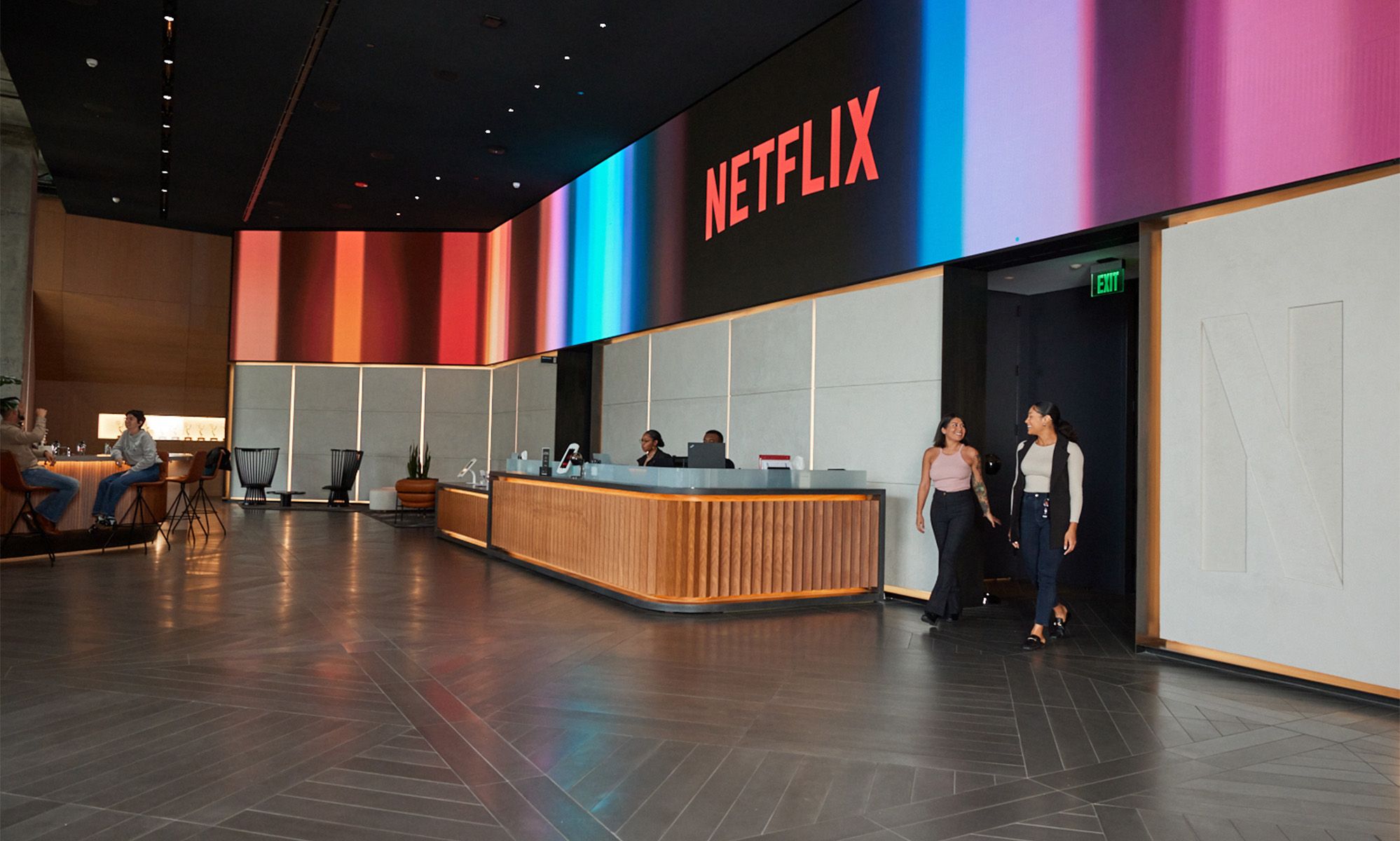
Netflix shares closed at their lowest level in more than two years. On Tuesday (17), the stock ended the Nasdaq session at $59.68, down 1.76% for the day and about 35% year to date in 2026, after hitting a new 52-week low of $59.41. With the drop, the company is now worth about $245 billion and trades at 18.5 times trailing earnings — below the S&P 500's 23 times and roughly 70% below the multiple it commanded at its June 2025 peak. The move does not reflect an operational collapse: revenue is still growing at a double-digit pace and operating margin is above 30%. What changed is how much the market is willing to pay for that growth.
The price changed; the numbers did not
The decline did not come from a single event. Since the third-quarter earnings release on October 20, when the stock fell 5.3% to close at $65.04, shares have not recovered the lost ground. That day, the company reported $12.9 billion in revenue and profit above consensus, but guided to a weaker fourth quarter and cut its advertising revenue forecast. The market chose to focus on the second half of the release.
Since then, the stock has lost another 8% and reached its lowest level since August 2024. It is now 53% below its all-time high, set at the June 2025 peak, and trades near the bottom of its 52-week range of $59.41 to $113.34. By market value, Netflix remains one of the largest media companies in the world, but it is no longer treated as a first-tier growth stock.
Comparing the price with the company's own numbers helps separate perception from deterioration. In the third quarter, revenue totaled $12.874 billion, up 11.8% year over year. Operating income rose 37% to $4.459 billion, and operating margin jumped from 28.2% to 34.6%. Net income reached $3.664 billion, up 43.9%, with diluted earnings per share of $0.87, compared with $0.59 a year earlier.
The full figures are in the third-quarter shareholder letter, which also details the share buyback and the full-year outlook. The contrast between operating performance and the market reaction explains the company's current moment: profitable, mature and under pressure to grow fast again.
An 18.5 multiple: what the market is saying
The price-to-earnings ratio (P/E) is the market's simplest yardstick: it shows how many years of current profit an investor is willing to pay for a company. At 18.5 times, Netflix is cheaper than the average of the 500 largest US companies, which trades at 23 times. For a company that once commanded fast-growth multiples, the gap is the portrait of a reclassification.
That reclassification has a name: multiple compression. When earnings grow but the price falls, the market is saying it does not believe the pace will continue. The current multiple represents a discount of about 70% against what the stock was worth at its June 2025 peak, according to a Motley Fool calculation. It is not a matter of the company earning less — it earns more — but of investors demanding a faster return to keep their money there.
The practical effect is that the stock needs less growth to look cheap, but it also loses the benefit of the doubt. If revenue accelerates again, the multiple has room to recover. If growth settles in the low double digits, Netflix tends to be priced as a mature media company, not a technology platform. It is the same debate the market has had with Disney, Warner Bros. Discovery and Paramount for years, now applied to the company that built streaming at global scale.
Why investors are skeptical
Engagement under scrutiny
The first reason is viewing time. In September, Wells Fargo cut its rating to "underweight," citing an 8% drop in viewing time per subscriber in the first half of 2026. HSBC downgraded the stock from buy to neutral on September 22, when shares were trading at $73.36. Both banks pointed to the same problem: a lack of big original series able to hold audiences, and the sense that some viewers drop a show after its first season.
The reading has merit, even if it may be exaggerated. Netflix argues that the catalog is broad and that weaker engagement on specific titles does not mean cancellation. The quarter's numbers show the base still at 325 million subscribers and consumption of non-English titles rising from less than 10% to more than a third of the total. The problem is that the market now demands attention metrics, not just subscriber counts — and the company discloses fewer and fewer data points on hours viewed.
Revenue decelerating quarter after quarter
The second reason is arithmetic. After growing 17.6% in the fourth quarter of 2025, revenue decelerated for three straight quarters: 11.8% between July and September 2026, with 11.5% expected for the fourth quarter. For the full year, the company projects $51.1 billion, up 13% — below its 19.6% average annual growth over the past decade and not enough to sustain the growth premium the stock carried for years.
Advertising, billed as the next growth leg, also disappointed. The 2026 ad revenue forecast was cut from about $3 billion to roughly $2.7 billion because of a slower rollout of ad features. The company is sticking with its plan to expand the ad tier to 15 new countries in 2027, starting with nine markets in Europe, the Middle East and Africa in March, plus Colombia, Peru and New Zealand. The market, however, wanted to see a bigger business before paying for it.
"We know there is some investor concern about growth in our hours viewed. Member response to our 2026 price increases is consistent with prior changes and with our expectations, an indication that our engagement — which spans the quantity, quality and variety of viewing — remains healthy."
What weighs on the cash flow
The third reason is cost. Netflix is expected to spend about $20 billion on content in 2026, and the bet on live events — NFL games, boxing matches and specials — consumes more than 5% of that budget while accounting for about 1% of viewing hours, according to research cited by analysts. Content asset additions rose 32% to $9.8 billion, while free cash flow fell to $1.5 billion.
The company also trimmed its structure. About 1,000 jobs were cut, equivalent to 6% of the workforce, the largest reduction in years. Content chief Bela Bajaria left, replaced by Peter Rice, and film head Dan Lin also departed. The impact shows up in guidance: fourth-quarter operating margin is expected to fall to 26%, with about 120 basis points of effect from the layoffs.
There is also competition for attention. YouTube, TikTok and Instagram compete for the same free time, often for free. Every minute spent on those platforms is a minute not spent on a Netflix series, and the market knows it when pricing the stock.

| Metric | Value |
|---|---|
| Share price (Nov. 17, 2026) | $59.68 |
| 2026 decline | about 35% |
| 52-week range | $59.41 – $113.34 |
| P/E ratio | 18.5x (S&P 500: 23x) |
| Q3 revenue | $12.874bn (+11.8%) |
| Q3 operating margin | 34.6% |
| 2026 revenue guidance | $51.1bn (+13%) |
What still supports the case
On the positive side, the cash machine keeps working. The 34.6% operating margin in the third quarter is among the highest in the sector, and the company repurchased 63.9 million shares for $4.8 billion in the period, the largest buyback in its history, with $22.3 billion still authorized. A buyback that size reduces the share count and tends to support earnings per share even with slower growth.
The fourth-quarter calendar is also the busiest of the year: the first NFL game on Thanksgiving Eve, a Christmas Day doubleheader and the Tyson Fury vs. Anthony Joshua fight. These broadcasts combine subscriptions, advertising and sponsorship in a single product and explain why the company insists that the heart of the service remains TV, film and live events, which account for almost all of its revenue.
In addition, the company is holding to a 31.5% full-year operating margin target despite the weaker quarter. If it delivers, Netflix ends 2026 with higher operating profit than in 2025 and with cash to keep buying back stock — a cushion few media companies have.
Management acknowledges the skepticism but disputes the diagnosis. In September, co-CEO Ted Sarandos admitted the company "isn't growing as fast as I'd like" and defended its content plan. The remark, unusually blunt, was read as a sign that the company knows the problem but has no quick fix for it.
Analysts split, and what to watch until January
Research houses do not share a single answer. Barclays cut its price target from $80 to $70 in October; Wedbush lowered its target from $90 to $80 while keeping an outperform rating; MoffettNathanson remains at buy with a $90 target. New Street Research urged skepticism toward a strategy that doubles down on premium TV, film and live events while Netflix stays out of the fastest-growing areas, such as short-form video and mobile.
| Firm | Move | Target |
|---|---|---|
| HSBC (Sept. 2026) | Buy to neutral | — |
| Wells Fargo (Sept. 2026) | Cut to underweight | — |
| Barclays (Oct. 2026) | Target cut | $70 |
| Wedbush (Oct. 2026) | Target cut, keeps outperform | $80 |
| MoffettNathanson | Keeps buy | $90 |
The gap between the current price and the targets — even the most conservative implies nearly 17% upside — shows the market is not pricing in bankruptcy, but uncertainty about the pace. That is the kind of discount that only closes with numbers.
The next test is the fourth-quarter report, expected in late January 2027. Three points deserve attention: advertising revenue, which needs to show reacceleration after the guidance cut; operating margin, which should return to the 30% range after the layoffs; and any more detailed disclosure on viewing time, a topic the company has historically handled sparingly.
For industry watchers, the conclusion is less binary than the headline suggests. Netflix is cheaper than at any point in the past two years and, for the first time, trades below the market average. But cheap, in stocks, is always a relationship between price and expectation. The expectation today is deceleration — and that is what the stock is paying for. Watching the fourth-quarter results and comparing them with the third-quarter figures helps gauge whether the discount is an opportunity or a warning. More context on the company is in the series section.
Suggested and related articles

Minimum Wage on Netflix: Release Date and How to Watch

Planeswalker: When Does the Magic Series Hit Netflix?
HBO Max Reaches 3.1M UK Homes in Barb Debut

Netflix November 2026: Black Doves Leads Strong Slate

Magic: The Gathering Could Outshine Arcane on Netflix